Skip to content
-
  • https://www.facebook.com/
  • https://twitter.com/
  • https://t.me/
  • https://www.instagram.com/
  • https://youtube.com/
Web Digital PR Logo Web Digital PR Logo Web Digital PR

Verified News. Real Impact.

Web Digital PR Logo Web Digital PR Logo Web Digital PR

Verified News. Real Impact.

  • News
        • Latest News
        • Breaking News
        • Trending
        • Editor's Picks
        • ── By Category ──
        • Business
        • Technology
        • Startups
        • Digital Marketing
        • AI & Innovation
        • Finance
        • ── Features ──
        • Interviews
        • Announcements
  • Industries
        • SaaS
        • eCommerce
        • Healthcare
        • Finance & FinTech
        • Travel & Hospitality
        • Real Estate
        • Education
        • Manufacturing
        • Media & Entertainment
  • Press Releases
        • All Press Releases
        • Latest Releases
        • Featured Releases
        • By Industry
        • Submit a Press Release
        • PR Guidelines
        • Editorial Policy
  • Insights
        • Expert Opinions
        • Industry Reports
        • Market Trends
        • SEO & Marketing
        • AI in Business
  • About Us
        • About Us
        • Get in Touch
        • Advertise
  • News
        • Latest News
        • Breaking News
        • Trending
        • Editor's Picks
        • ── By Category ──
        • Business
        • Technology
        • Startups
        • Digital Marketing
        • AI & Innovation
        • Finance
        • ── Features ──
        • Interviews
        • Announcements
  • Industries
        • SaaS
        • eCommerce
        • Healthcare
        • Finance & FinTech
        • Travel & Hospitality
        • Real Estate
        • Education
        • Manufacturing
        • Media & Entertainment
  • Press Releases
        • All Press Releases
        • Latest Releases
        • Featured Releases
        • By Industry
        • Submit a Press Release
        • PR Guidelines
        • Editorial Policy
  • Insights
        • Expert Opinions
        • Industry Reports
        • Market Trends
        • SEO & Marketing
        • AI in Business
  • About Us
        • About Us
        • Get in Touch
        • Advertise
Close

Search

Submit PR
Web Digital PR Logo Web Digital PR Logo Web Digital PR

Verified News. Real Impact.

Web Digital PR Logo Web Digital PR Logo Web Digital PR

Verified News. Real Impact.

  • News
        • Latest News
        • Breaking News
        • Trending
        • Editor's Picks
        • ── By Category ──
        • Business
        • Technology
        • Startups
        • Digital Marketing
        • AI & Innovation
        • Finance
        • ── Features ──
        • Interviews
        • Announcements
  • Industries
        • SaaS
        • eCommerce
        • Healthcare
        • Finance & FinTech
        • Travel & Hospitality
        • Real Estate
        • Education
        • Manufacturing
        • Media & Entertainment
  • Press Releases
        • All Press Releases
        • Latest Releases
        • Featured Releases
        • By Industry
        • Submit a Press Release
        • PR Guidelines
        • Editorial Policy
  • Insights
        • Expert Opinions
        • Industry Reports
        • Market Trends
        • SEO & Marketing
        • AI in Business
  • About Us
        • About Us
        • Get in Touch
        • Advertise
  • News
        • Latest News
        • Breaking News
        • Trending
        • Editor's Picks
        • ── By Category ──
        • Business
        • Technology
        • Startups
        • Digital Marketing
        • AI & Innovation
        • Finance
        • ── Features ──
        • Interviews
        • Announcements
  • Industries
        • SaaS
        • eCommerce
        • Healthcare
        • Finance & FinTech
        • Travel & Hospitality
        • Real Estate
        • Education
        • Manufacturing
        • Media & Entertainment
  • Press Releases
        • All Press Releases
        • Latest Releases
        • Featured Releases
        • By Industry
        • Submit a Press Release
        • PR Guidelines
        • Editorial Policy
  • Insights
        • Expert Opinions
        • Industry Reports
        • Market Trends
        • SEO & Marketing
        • AI in Business
  • About Us
        • About Us
        • Get in Touch
        • Advertise
Close

Search

Submit PR
Home/Uncategorized/India’s Battery Storage Revolution: How BESS Is Becoming the Missing Link in the Green Energy Grid
BESS India, battery energy storage India, green energy India, India renewable energy 2026, solar storage India, grid-scale battery storage, India power sector, energy transition India, CEA battery regulations, SECI tenders, sodium ion battery India, clean energy India, India 500 GW target, battery storage boom India, peak power demand India
Uncategorized

India’s Battery Storage Revolution: How BESS Is Becoming the Missing Link in the Green Energy Grid

By Nick A
June 30, 2026 5 Min Read
Updated on June 29, 2026

Introduction

India has crossed 250 GW of installed renewable energy capacity — a milestone that would have seemed impossibly ambitious a decade ago. Solar and wind power are now the cheapest sources of bulk electricity the country has ever had. Yet every evening, as the sun sets and millions of households switch on their lights and fans, the grid faces a brutal question: where does the power come from? The answer, for too long, has been coal plants kept running just in case. That is now changing. Battery Energy Storage Systems — BESS — are emerging as the single most important missing piece in India’s clean energy puzzle, and 2026 is shaping up as the year they finally move from pilot project to power grid backbone.

What Is BESS and Why Does India Need It?

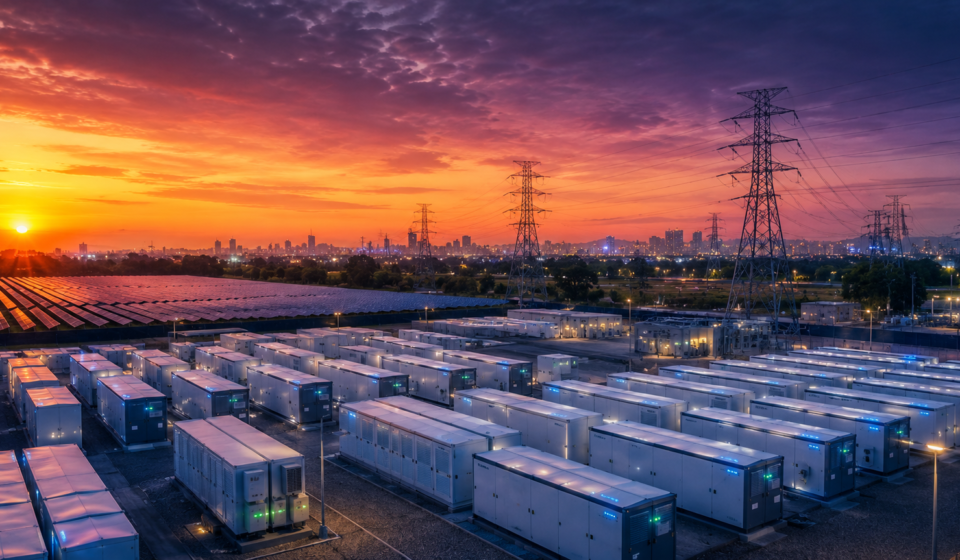
A Battery Energy Storage System is exactly what it sounds like: a large-scale electrochemical system that stores electricity when it is available cheaply and releases it when demand peaks. In India’s context, that means capturing solar energy generated during the middle of the day and dispatching it during the evening demand surge — the gap that has historically forced grid operators to keep inefficient coal plants spinning on standby.

The problem is structural. Solar energy peaks at noon; demand peaks at 7 p.m. Wind power is seasonal and geographically concentrated. Without storage, renewable energy remains an “as-available” resource rather than a firm, dispatchable one. Every time India adds more solar capacity without matching storage, it deepens this mismatch. The result: renewable energy is often curtailed — wasted — even as coal plants burn fuel to meet peak loads. BESS directly closes that gap, allowing a solar plant to essentially time-shift its output and deliver green electricity on demand.

The Numbers Behind the Boom

The scale of India’s BESS buildout is striking. As recently as 2025, India had less than 1 GWh of installed grid-scale battery storage — a fraction of what its renewable ambitions demand. By the end of 2026 alone, industry estimates project installed battery storage to reach approximately 5 GWh, a nearly tenfold jump in a single year. The pipeline is even more impressive: 69 new BESS tenders totalling 102 GWh were issued in just the past year, with a project pipeline already exceeding 92 GWh. By 2033, cumulative installed BESS capacity is projected to reach around 346 GWh — a market transformation happening faster than almost any analyst predicted.

Supporting this, the Central Electricity Authority (CEA) introduced new Technical Standards for BESS projects in 2026, effective from April 2027, mandating grid stability capabilities including active power control, voltage regulation, and frequency response. Large-scale systems of 50 MW or above must also carry “black start” capability — the ability to help restart the entire grid after a shutdown — and must deliver at least 90% of their original output after five years. These are not just technical rules; they signal that India is treating BESS as serious, permanent infrastructure rather than an experimental add-on.

Who Is Driving It and How

India’s BESS push is being led simultaneously from multiple directions. The Solar Energy Corporation of India (SECI) has restructured its renewable energy tenders to prioritise “firm and flexible” power rather than just installed megawatts — a shift that makes storage a procurement requirement, not an option. State governments and industrial clusters, battered by 2026’s record peak power demand of 270.82 GW, are increasingly turning to BESS for energy cost management and grid independence. Data centres, which cannot afford outages, are adopting BESS not as backup but as a primary energy management tool.

On the technology side, India is not limiting itself to lithium-ion. Under the Advanced Chemistry Cell (ACC) Battery Production Linked Incentive scheme, domestic manufacturing of battery cells is being actively incentivised, with parallel investment going into sodium-ion battery research and battery recycling infrastructure — reducing India’s dependence on imported critical minerals.

The Bigger Picture

BESS is not just an energy story; it is an economic and climate story. Every gigawatt-hour of battery storage installed reduces the hours India’s coal plants need to run on standby, cutting both fuel costs and carbon emissions. It enables India to genuinely deliver on its 500 GW non-fossil energy target by 2030 — not just in terms of capacity installed, but in terms of reliable electricity actually reaching consumers around the clock. Solar and wind that once had to be curtailed can now be stored, sold, and used, improving the financial returns on renewable investments and attracting more private capital into the sector.

Conclusion

India’s battery storage revolution is not a future ambition — it is already under construction, tender by tender, gigawatt-hour by gigawatt-hour. BESS is rapidly becoming what the transformer was to the last century’s electricity grid: the invisible infrastructure that makes everything else work. As India races toward its clean energy goals against the backdrop of record heatwaves and rising power demand, getting battery storage right is no longer optional. It is the hinge on which the entire green energy transition turns.


Frequently Asked Questions

What is BESS in India’s energy sector?

BESS stands for Battery Energy Storage System — large-scale battery installations that store surplus solar or wind energy and release it during peak demand periods, solving the intermittency problem of renewables.

How big is India’s BESS market in 2026?

India’s installed battery storage is projected to jump from under 1 GWh in 2025 to approximately 5 GWh by end of 2026, with a pipeline exceeding 92 GWh already in development.

Why is battery storage important for India’s renewable energy goals?

India targets 500 GW of non-fossil capacity by 2030, but solar and wind alone cannot guarantee reliable power. BESS bridges the gap between when renewables generate power and when consumers need it.

Which technologies are used in India’s battery storage systems?

Lithium-ion dominates currently, but India is also investing in sodium-ion batteries and supporting domestic manufacturing through the ACC Battery PLI scheme.

What new regulations govern BESS in India?

The CEA’s 2026 Technical Standards (effective April 2027) require large BESS projects to support grid stability, carry black-start capability, and maintain at least 90% output capacity for five years.


Tags:

battery energy storage Indiabattery storage boom IndiaBESS IndiaCEA battery regulationsclean energy Indiaenergy transition Indiagreen energy Indiagrid-scale battery storageIndia 500 GW targetIndia power sectorIndia renewable energy 2026labour productivity heatSECI tenderssodium ion battery Indiasolar storage IndiaUS EV market slowdown
Author

Nick A

Follow Me
Other Articles
EV vs petrol cars, global EV sales 2026, electric vehicles future, EV adoption timeline, petrol car phase out, BloombergNEF EV outlook, China EV market, India EV market, US EV policy, electric car sales record, battery cost decline, EV charging infrastructure, road transport fuel demand, ICE vehicle ban, clean transport 2026
Previous

Will EVs Really Outnumber Petrol Cars? Here’s What the 2026–2047 Data Actually Says

Ozempic exercise 2026, GLP-1 fitness, Wegovy workout, Ozempic muscle loss, GLP-1 weight loss exercise, semaglutide fitness plan, weight management fitness 2026, exercise on Ozempic, ACSM weight management trend, GLP-1 India, obesity medication exercise, personal training GLP-1, resistance training weight loss, Mounjaro fitness, NASM GLP-1 training
Next

Ozempic Changed Weight Loss — Now Fitness Experts Are Rethinking Everything About Exercise

No Comment! Be the first one.

Leave a Reply Cancel reply

Your email address will not be published. Required fields are marked *

Recent Posts

  • Wearable Tech to AI Coaches: How Technology Is Completely Changing the Way We Fitness in 2026
  • Ozempic Changed Weight Loss — Now Fitness Experts Are Rethinking Everything About Exercise
  • India’s Battery Storage Revolution: How BESS Is Becoming the Missing Link in the Green Energy Grid
  • Will EVs Really Outnumber Petrol Cars? Here’s What the 2026–2047 Data Actually Says
  • El Niño Meets Climate Change: Inside India’s Record-Breaking 2026 Heatwave

Archives

  • July 2026
  • June 2026
  • May 2026

Categories

  • AI & Innovation
  • Breaking News
  • Business
  • Digital Marketing
  • Finance
  • Health & Fitness
  • Industry Reports
  • Latest News
  • Startups
  • Technology
  • Travel & Hospitality
  • Trending
  • Uncategorized

Company

  • About Us
  • Get in Touch
  • Advertise

Content

  • Latest News
  • Industries
  • Insights

Press Release

  • Submit Press Release
  • PR Guidelines
  • Editorial Policy

Legal

  • Privacy Policy
  • Terms of Use
  • Sitemap
Copyright 2026 — Web Digital PR. All rights reserved.