Wearable Tech to AI Coaches: How Technology Is Completely Changing the Way We Fitness in 2026

Introduction
Not long ago, getting fit meant showing up at a gym, following a generic programme pinned to a noticeboard, and guessing whether you were improving. In 2026, that world is almost unrecognisable. Your smartwatch already knows your resting heart rate variability before you drink your morning coffee. An AI coach has pre-adjusted your workout based on last night’s sleep score. And the app on your phone is nudging you not to skip leg day — because your recovery metrics say you are ready. For the third consecutive year, the American College of Sports Medicine (ACSM) has ranked Wearable Technology the number one global fitness trend, and the gap between technology-assisted training and old-school guesswork has never been wider. Here is exactly how the revolution is unfolding — and what it means for the way the world exercises.
Wearables: From Step Counters to Full Physiological Dashboards
The first generation of fitness wearables counted steps and estimated calories — metrics that were useful but shallow. The 2026 generation is doing something fundamentally different: building a real-time physiological picture of each user and feeding it directly into training decisions.
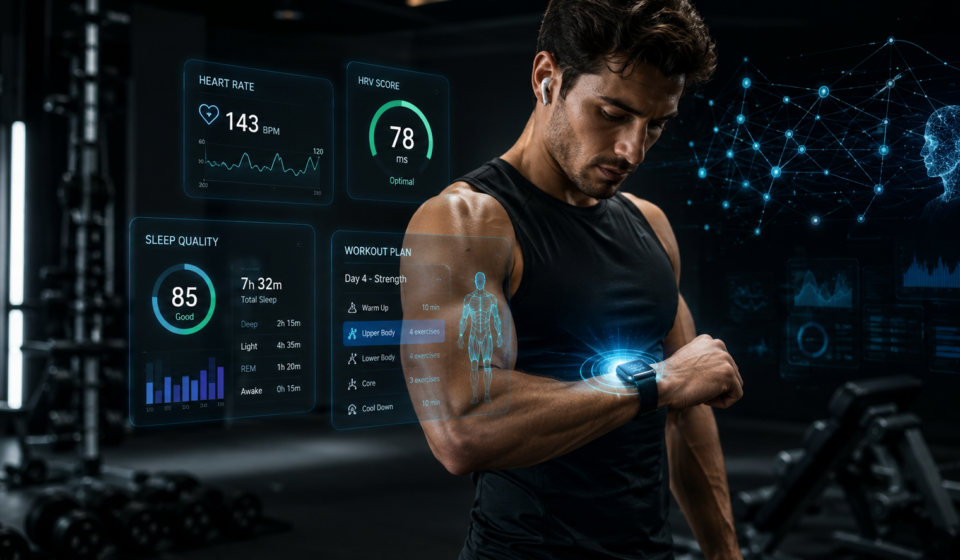
Today’s leading wearables — Apple Watch, WHOOP, Garmin, Oura Ring, and a growing wave of competitors — now track heart rate variability (HRV), VO₂ max estimates, sleep quality scores, blood oxygen saturation, skin temperature, stress levels, and in some models, continuous glucose monitoring. Nearly half of US adults now own a fitness tracker or smartwatch, and the question in 2026 is no longer whether people will use wearables — it is how deeply that data will shape their behaviour.
Advanced biosensors are now capable of detecting falls or crashes, monitoring respiratory rate during exercise, and integrating cycle tracking with training load recommendations for women. The leap from tracking to programming is the defining shift: wearables are no longer passive recorders of what your body did. They are becoming active directors of what your body should do next.
AI Coaches: The Personal Trainer in Your Pocket
Wearable data is only as powerful as the intelligence interpreting it. This is where AI coaching has stepped in to close the loop — and the results are reshaping what personal training looks like at scale.
AI fitness platforms in 2026 ingest data from wearables continuously and use it to adjust training plans in real time dynamically. Missed your deep sleep target? Your AI coach deprioritises heavy lifting and pivots to mobility work. Your HRV trend is strong after three weeks of consistent training? The system increases training load to capitalise on your readiness window. This kind of responsive, data-driven programming was previously available only to elite athletes with full-time sports science support. Today it is embedded in consumer apps costing less than a monthly gym membership.
The ACSM notes this shift as moving fitness from “tracking” to “programming” — where a workout is no longer planned around habit or guesswork, but around your physiology, updated in real time. Personal trainers who once relied on intuition and general periodisation principles are now upskilling in data interpretation, learning to read HRV trends and recovery scores as fluently as they once read body language and effort levels.
Crucially, AI is not replacing human coaches — it is making them sharper. The National Academy of Sports Medicine (NASM) and ACE both report that trainers increasingly use AI to research programming, outline plans, and prepare content, freeing up more time for the human accountability and emotional connection that no algorithm can replicate.
Mobile Apps, Virtual Reality, and the Community Layer
Beyond wearables and AI coaching, the fitness tech ecosystem in 2026 is expanding in two more directions: immersive training environments and social fitness communities.
Virtual reality workouts are gaining traction as a solution to the motivation problem — making exercise feel less like a chore and more like an experience. Platforms blending VR with cardio and functional training are reporting strong engagement rates, particularly among users who historically struggled to maintain gym attendance.
Meanwhile, fitness apps are doubling down on community features. Platforms like Strava and Peloton are building social layers that transform solo training into shared experiences — with challenges, leaderboards, and group accountability driving consistency in ways that individual willpower rarely can. Run clubs, walking groups, and creator-led training communities are exploding, meeting the simultaneous demand for fitness results and social connection that defines the post-pandemic wellness consumer.
What This Means for You
The practical upshot of 2026’s fitness technology revolution is remarkably democratic. Elite-level physiological insights — the kind that once required laboratory testing and sports science teams — are now available to anyone with a mid-range smartwatch and a data-literate coaching app. Consumers are spending an estimated $60 billion supporting their health, fitness, and exercise goals this year, and an increasing share of that spend is going into tech-enabled, personalised experiences rather than generic gym memberships.
Conclusion
The gym of 2026 is not just a room with weights. It is an ecosystem of connected devices, intelligent software, and data-driven decisions that knows your body as well as any coach ever could — and gets smarter with every session. Whether you are an elite athlete chasing marginal gains, a busy professional trying to fit 30 minutes of movement into a hectic day, or someone managing a chronic health condition through structured exercise, technology has made personalised, evidence-based fitness more accessible than at any point in human history. The question is no longer whether tech belongs in your fitness routine. It is whether you can afford to train without it.
Frequently Asked Questions
What is the number one fitness trend worldwide in 2026? According to the American College of Sports Medicine’s annual Worldwide Fitness Trends survey of 2,000 fitness professionals, wearable technology is the number one fitness trend globally for 2026, holding the top spot for the third consecutive year.
How do AI fitness coaches work? AI fitness coaches use data from wearables — including HRV, sleep quality, recovery scores, and activity history — to dynamically adjust workout plans in real time, providing personalised programming that responds to your body’s actual readiness rather than a fixed schedule.
What health metrics can wearables track in 2026? Modern fitness wearables now track heart rate variability, VO₂ max, sleep stages, blood oxygen, skin temperature, stress levels, respiratory rate, and in some devices, continuous glucose levels — giving users a near-complete physiological dashboard.
Are AI personal trainers replacing human coaches? No. AI is enhancing human coaches by handling programming logistics, data analysis, and content preparation, freeing trainers to focus on motivation, accountability, and the emotional connection that technology cannot replicate.
Which fitness apps are most popular in 2026? Strava, Peloton, WHOOP, Apple Fitness+, and a growing ecosystem of AI-powered coaching apps are among the most widely used, with community-driven features and real-time data integration emerging as the key differentiators.